A research citation is most useful when the claim beside it preserves the question the experiment was designed to answer. That question includes more than an ingredient. It includes the preparation, the alternative against which it was assessed, the people observed and the outcome being compared. Moving from that defined setting to a different prescription, retail product or care service introduces assumptions that deserve their own examination.
This article treats those assumptions as scientific questions rather than reasons to dismiss research. A precise result can support a precise conclusion while leaving a broader application unresolved. The analysis below explains how to identify the original comparison, interpret its numerical meaning and specify the additional evidence that would support an extension. Hypothetical calculations and proposed study designs illustrate the reasoning; they are not extra clinical observations or instructions for treatment.
Study figure and data
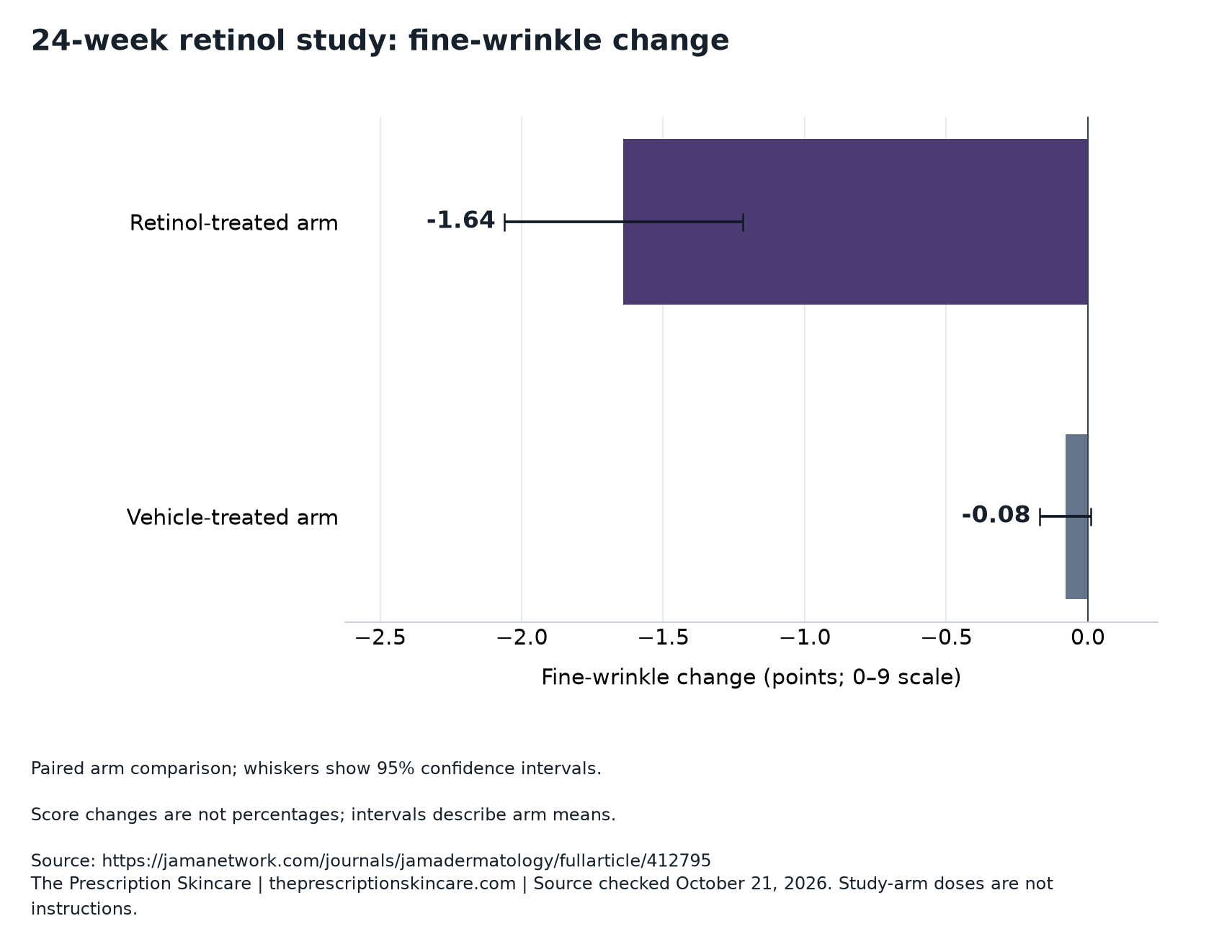
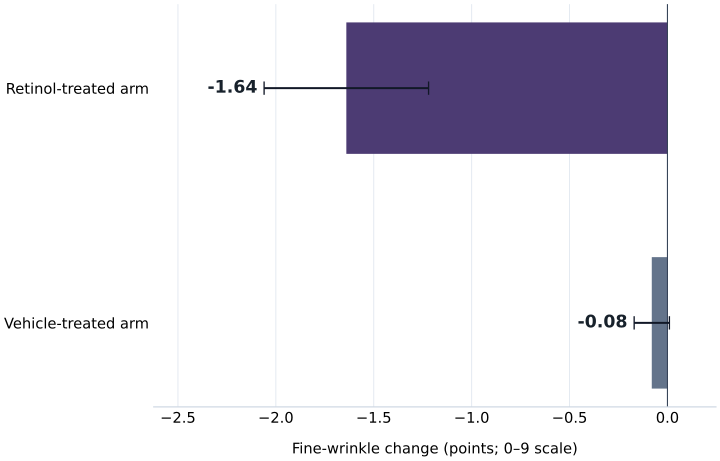
Paired arm comparison; whiskers show 95% confidence intervals.
Score changes are not percentages; intervals describe arm means.
Download source-labeled chart (PNG)Download chart data (CSV)Download vector chart (SVG)
| Study group | Reported value | 95% confidence interval |
|---|---|---|
| Retinol-treated arm | -1.64 | -2.06 to -1.22 |
| Vehicle-treated arm | -0.08 | -0.17 to 0.01 |
Sections in this article
The treatment claim needs a named alternative
A statement that a treatment improves an outcome is incomplete until the alternative is specified. The relevant effect could concern adding an ingredient to a base, choosing one finished preparation over another, or entering one care pathway instead of another. Those contrasts can all be reasonable research objectives, but they need not produce the same answer.
Imagine a proposed experiment comparing preparation A with its base alone. The question concerns the difference between those two conditions. Now imagine another experiment comparing a clinical service that may offer several preparations with an existing care pathway. That question concerns a package of decisions and support. A citation from the first experiment cannot, without additional reasoning, provide the result of the second.
The guide to reading a prescription formula helps identify the preparation under discussion. For scientific appraisal, the next step is to write the full contrast in a sentence. Specify the alternative as carefully as the active condition. This makes it possible to distinguish an ingredient-level investigation from a claim about a finished product or the organization delivering care. The distinction defines the evidence needed rather than assigning an automatic verdict to any product.
| Claim under examination | Comparison to specify | What the comparison would address |
|---|---|---|
| An ingredient adds benefit | Preparation with the ingredient versus a suitable matched base | The added contribution under those conditions |
| One formula performs better | The two complete preparations | Their comparative performance on a defined outcome |
| A service improves outcomes | The service pathway versus a defined alternative pathway | The effect of the care strategy being offered |
| Results apply in another setting | The target population and setting | Whether the proposed extension is supported |
Keep the preparation, person and treatment site distinct
Formulation identity is not established solely by a familiar ingredient name. A defensible link between two preparations would have to describe what is shared and what differs, then explain why those differences do or do not matter for the proposed outcome. A concentration ratio alone supplies arithmetic, not a clinical comparison between complete formulations.
The design also determines the unit of independent information. With paired sites, a person contributes observations under both conditions. Treating those observations as if they came from unrelated participants would disregard their connection. The meaningful comparison is organized within people, while recruitment determines which people the findings describe. Random assignment can support an internal comparison without making the sample representative of every intended user.
Our discussion of standard prescriptions and personalized formulas provides another way to frame the identity question. A transfer claim should identify its target precisely: the substance, preparation, body area and population. An unmatched characteristic is a reason to investigate applicability, not a license to guess a numerical correction. The useful research response is to test the relevant difference or present a justified argument for why the original comparison remains informative.
Usual care changes what an experiment is estimating
Usual care is not a universal control condition. It has to be described. In a proposed study, it might involve a defined existing pathway, access to additional products or decisions made during follow-up. If those features differ between settings, the question answered by the comparison can differ too. Calling both alternatives usual care would not make them identical.
Consider a hypothetical service trial in which one group receives an organized follow-up pathway and another continues an established pathway. A prespecified outcome could compare the strategies as offered, including the decisions and participation that follow assignment. A different design might instead hold visits and other care constant to isolate a preparation. Neither design is inherently the answer to every question. The important issue is whether the analysis matches the claim.
This distinction is useful when interpreting product-evidence language. Experimental control can clarify a narrow contrast, while a study closer to ordinary practice can examine a broader strategy. Greater resemblance to practice does not automatically remove bias, and tighter control does not automatically establish applicability everywhere. A transparent account should state which conditions were controlled, which were allowed to vary and what conclusion that design was intended to support.
An absolute difference should retain its original meaning
A change over time and a difference between conditions are separate quantities. The first describes movement within a condition. The second uses the comparator to ask how much that movement differs. A clear report should preserve that distinction rather than presenting whichever number sounds larger as though it were the only result.
For a deliberately invented example, suppose a score starts at twenty in both conditions. It ends at sixteen in one and eighteen in the other. The within-condition decreases are four and two points; the difference in decrease is two points. The first decline is one fifth of its starting score, but that does not establish that one fifth of physical wrinkles disappeared or that one fifth of participants benefited. Each interpretation would require a different measurement or denominator.
A related issue appears in the concentration-comparison analysis: the absence of a detected difference should not be substituted for a formal demonstration of equivalence. Meaning follows from the outcome definition and the analysis, not from an appealing numerical transformation. A treatment claim should therefore retain the scale units, state the contrast being interpreted and distinguish measured effects from new arithmetic or predictions about individual users.
The observed treatment experience includes interruptions
Staff averaged 1.6 applications weekly (planned up to three), with irritation-related withholding.
An exposure record describes what occurred, whereas a schedule describes what was intended or permitted. If discomfort affects exposure, an outcome estimate concerns the experience actually represented in the analysis. Comparing people with more and fewer applications afterward would also compare the reasons their exposure differed. Such a comparison cannot automatically identify a preferred schedule or isolate a dose effect.
Unavailable outcomes add another decision. Intent-to-treat aims to retain participants according to assignment. Last observation carried forward uses an earlier available measurement when a later one is missing. In a hypothetical example, an earlier rating could be inserted into the final calculation despite the later state being unknown. A completer analysis avoids that substitution but restricts who contributes. A useful evidence record explains both the population analyzed and the assumptions used for missing values. It should also distinguish stopping treatment from ending observation, because collecting follow-up after an interruption can answer a different question from observing only uninterrupted use. These are matters of study interpretation, not personal scheduling advice.
A proposed biological explanation is a separate claim
Only significant biopsy findings were reported: glycosaminoglycans n=6; procollagen I n=4. Injury/ulcer protection remained hypothetical.
A laboratory measurement can contribute to a causal explanation, but an association between measurements does not identify the pathway by itself. A treatment might influence two observations through separate routes. To argue that one biological change accounts for a clinical outcome, researchers need a design and analysis that address the proposed sequence and plausible alternative explanations.
The completeness of reporting matters as well. When only selected findings are visible, an analyst needs information about the broader set of tests and the basis for selection. A striking result can be a reason for replication while leaving its reliability and clinical role unresolved. For a hypothetical future investigation, a protocol could identify the mechanistic measurements in advance, report all planned analyses and collect the clinical outcome the mechanism is expected to affect. That would make the proposed connection more assessable. It would still be necessary to distinguish evidence for the pathway from evidence for a different outcome or preparation. Biological plausibility gives an investigation direction; it does not complete the investigation.
Uncertainty about an estimate is not a forecast for one person
A confidence interval describes uncertainty about an estimated quantity under the statistical model and its assumptions. It is not the range containing a stated proportion of personal outcomes. The precision of a mean and the variation of individual responses are different questions. A review should not turn a group interval into a promise about what a particular reader will experience.
Standard error, often abbreviated SE, estimates the variability of an estimator. A confidence interval uses an interval-construction method rather than being another name for that error measure. When two displays use different bars or different analyzed populations, their appearance alone cannot support a direct comparison. The caption, population and outcome definition need to travel with the graphic.
Paired observations add a further constraint: uncertainty about their difference depends on how the measurements relate within individuals. Subtracting the lower and upper limits of separate intervals does not reconstruct the paired interval. Nor does a small P value tell us the size of a meaningful benefit. A careful interpretation keeps three questions distinct: what difference was estimated, how uncertain that estimate is, and what magnitude would matter for the decision under discussion.
Related investigations do not merge into one trial
The 1995 abstract describes 99 completers, 48 weeks and tretinoin 0.1% or 0.025% versus vehicle; higher strength produced more erythema and scaling. The 2005 randomized report studied 204 participants receiving 0.05% tretinoin emollient cream or vehicle for up to two years. Its abstract reports facial-photodamage improvement without numerical effect estimates or confidence intervals.
A synthesis can use different reports to develop a more precise question, but it should not silently join their populations or treat their preparations as arms of a shared experiment. Follow-up duration, outcome scales and clinical context can alter what a number means. A longer report does not supply a missing endpoint for another investigation, and a shared ingredient family does not create a direct comparison.
The guide to compounded topical preparations helps separate the documentary categories involved. For scientific reasoning, identify which report addresses the proposed claim and which merely supplies context. A formula-specific assertion needs evidence relevant to that preparation; a service assertion needs a suitable evaluation of the service strategy. The table below is a reading map, not an attempt to rank the treatments or infer a concentration conversion.
| Source | Material examined | Interpretive boundary |
|---|---|---|
| 1995 concentration report | Indexed primary abstract | A concentration comparison does not rank unrelated finished formulas. |
| 2005 longer-duration report | Indexed primary abstract | Longer follow-up does not establish every proposed outcome. |
| RENOVA 0.02% label | Current official labeling | The indication and warnings belong to the exact product. |
An evidence record should expose its boundaries and interests
Four investigators disclosed conditional patent royalties; that does not establish funding or received payments. A documented interest should remain available for appraisal alongside the methods and results. It should neither be concealed nor expanded into an unsupported assertion about sponsorship. Independent replication and transparent reporting are questions to pursue rather than conclusions supplied by a disclosure alone.
RENOVA 0.02% labeling concerns adjunctive mitigation of fine facial wrinkles with comprehensive skincare and sunlight avoidance. It does not claim wrinkle elimination or repair of sun-damaged skin. Safety and effectiveness beyond 52 weeks or above age 71 are not established; pregnancy or attempted pregnancy precludes use under its label. These statements concern that particular tretinoin cream.
A useful evidence record connects each assertion to the appropriate document and states the limits of access. It distinguishes a study result, a regulatory statement and an inference about another setting. Publication dates, source-check dates and changes to a commercial offer are separate pieces of information. An article can accurately describe an older experiment without treating every historical background statement as current prescribing guidance. That separation makes the record easier to inspect and correct when new evidence becomes available.
A care-service claim needs a care-service question
To evaluate a proposed service benefit scientifically, begin by defining what the service is expected to change. A biological outcome, completion of follow-up and clarity of communication are different outcomes. A study may reasonably examine more than one, but it should describe each and avoid substituting success on one for success on another.
For example, a hypothetical comparison of two care pathways could specify its outcomes and analysis population before recruitment, document changes in treatment, and continue collecting outcomes after discontinuation where appropriate. It would also need to explain how competing care and missing observations are handled. Those design choices determine what the result would mean; simply attaching the name of an ingredient trial would leave them unanswered.
The Nurx brand review and Musely brand review can be used to inspect documentary terms. They do not establish that either service delivers the experimental preparation or reproduces its outcomes. Our editorial interpretation is that the clinical claim and the service claim should remain separately verifiable. Research becomes more useful when its reach is described precisely: the original contrast remains intact, the proposed extension is explicit, and the next comparison needed to support that extension can be stated clearly.
Questions about the evidence
Why does the choice of comparator affect a treatment claim?
The effect being estimated is a contrast, so the alternative is part of its definition. Comparing a preparation with its base addresses a different question from comparing two care pathways. To interpret a claim, identify both conditions and the outcome they were intended to contrast. The active ingredient alone does not define that question.
Does a matching concentration establish equivalent finished products?
It establishes a similarity in one stated feature, not necessarily a clinical relationship between the complete preparations. A claim of equivalence needs a specified outcome, a meaningful margin and evidence from an appropriate comparison. Other formulation and study characteristics must be considered rather than assumed irrelevant because the printed concentrations match.
What should remain attached to a numerical result?
Keep its units, comparator, analyzed population, timing and uncertainty available. State whether it is a reported estimate or new arithmetic. A ratio calculated from a rating should not be relabeled as a physical change or a personal probability unless the measurement and analysis support that interpretation. Clear labeling preserves the result’s actual meaning.
Can a laboratory finding support a broader clinical hypothesis?
It can provide a rationale for investigating that hypothesis. Establishing the broader claim requires observations suited to the proposed outcome and evidence connecting the relevant steps in the explanation. A plausible pathway is not a substitute for that test. Reporting the full set of planned measurements also helps readers assess how much confidence to place in selected signals.
Why distinguish controlled research from a service evaluation?
The two may examine different interventions and different alternatives. A controlled experiment can isolate a narrow contrast; a service evaluation may examine a sequence of decisions and support as a strategy. Neither automatically supplies the other’s result. The appropriate design follows from a clearly stated claim, with the relevant outcomes and assumptions made explicit.
Editorial assessment
A defensible extension of research requires an explicit connection between the original experiment and the new claim. Preserve the preparation, comparator, outcome and analyzed population; then identify what changes in the proposed application. Some changes may be addressed through direct comparison, others through additional observation or a reasoned argument that itself needs scrutiny. The point is to make those steps visible. A clinical estimate becomes less informative when its identity is lost, and more useful when readers can see both the question it answers and the next question it raises.
Research access and limitations
The retinol paper was examined in full publisher text, including its clinical table footnote, Comment and financial disclosure. The 1995 and 2005 tretinoin reports were assessed through indexed primary abstracts; product-specific context uses current official RENOVA labeling. Individual data, supplements and trial-registry records were not independently reviewed. Numerical illustrations and proposed research designs are hypothetical. This educational analysis does not provide an individualized regimen.
Sources and access notes
Sources checked October 21, 2026. Access notes identify the material examined for this article.
- Improvement of naturally aged skin with vitamin A (retinol).
Full publisher research article, including original clinical table-image footnote, figure captions, Comment and Financial Disclosure; no supplements or individual data reviewed. · Checked October 21, 2026
- DailyMed - RENOVA- tretinoin cream
Official current labeling retrieved in full · Checked October 21, 2026
- Two concentrations of topical tretinoin (retinoic acid) cause similar improvement of photoaging but different degrees of irritation. A double-blind, vehicle-controlled comparison of 0.1% and 0.025% tretinoin creams.
Indexed original research abstract · Checked October 21, 2026
- Long-term efficacy and safety of tretinoin emollient cream 0.05% in the treatment of photodamaged facial skin: a two-year, randomized, placebo-controlled trial.
Indexed original research abstract · Checked October 21, 2026