A research finding becomes relevant to a prescription only through a series of specific connections. The product must match the intervention closely enough for the comparison to make sense. The condition and outcome must also match the question being asked. Finally, the circumstances of treatment matter: a tightly organized experiment and an ordinary consultation can involve different support, follow-up and decisions. A familiar ingredient name does not complete that chain of reasoning.
This analysis examines those connections through topical skincare research. Its purpose is to show how a conclusion changes when the formula, comparator or clinical question changes, without turning that uncertainty into an assumption that every product is equally effective. The guide to reading a prescription formula helps identify the written prescription; the scientific task is to establish which evidence belongs to that specific intervention and which additional claims still require investigation.
Study figure and data
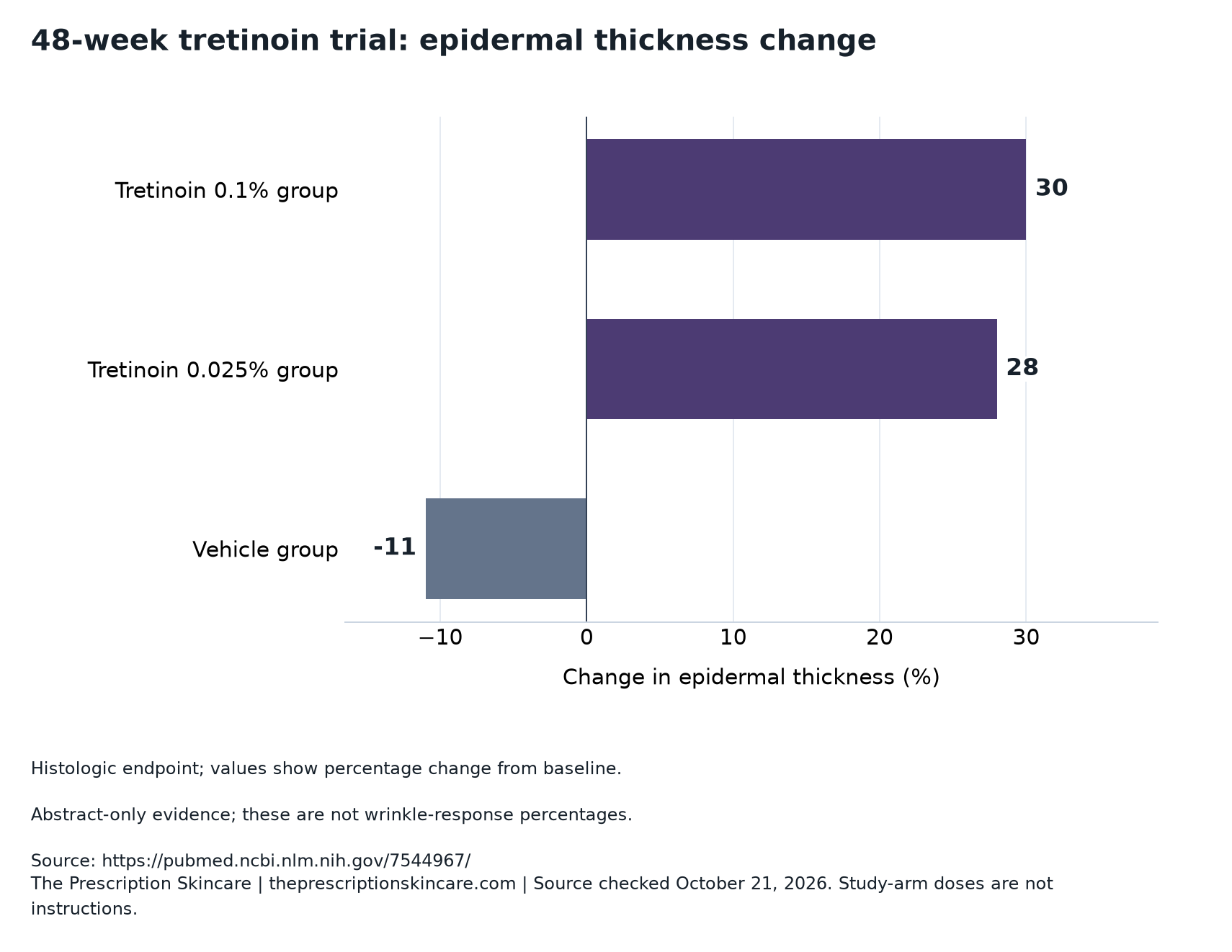
Histologic endpoint; values show percentage change from baseline.
Abstract-only evidence; these are not wrinkle-response percentages.
Download source-labeled chart (PNG)Download chart data (CSV)Download vector chart (SVG)
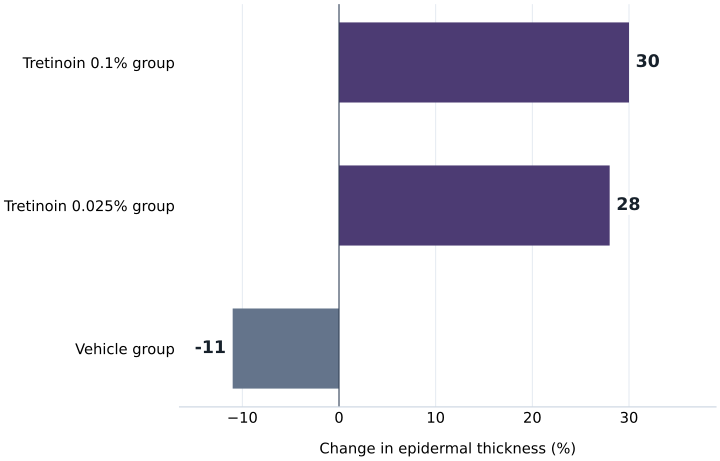
| Study group | Reported value |
|---|---|
| Tretinoin 0.1% group | 30 |
| Tretinoin 0.025% group | 28 |
| Vehicle group | -11 |
Sections in this article
Define the intervention beyond the ingredient name
A formula is an identifiable combination, not merely an ingredient attached to a percentage. To ask whether two products represent the same intervention, a researcher would need their compositions, physical forms, and relevant handling information. A study comparing complete products answers a question about those products together. It cannot isolate the effect of a single ingredient if other features change at the same time.
Consider a hypothetical comparison between Cream A and Cream B. Both list the same concentration of an active ingredient, but their bases differ. If outcomes differ, the comparison alone cannot assign that difference to the base, the interaction between base and active ingredient, or another unmeasured feature of use. If outcomes appear similar, that observation also does not show that every formulation sharing the percentage will behave similarly.
The first scientific step is therefore a statement of identity precise enough for another investigator to reproduce the comparison. Our editorial interpretation is that a product description should preserve these distinctions rather than use an ingredient name as shorthand for an entire evidence dossier. Standard prescriptions and personalized formulas raise this same question at the level of the documented prescription.
Read the experiment as a bounded comparison
In the 1995 indexed abstract, 99 photoaged participants completed 48 weeks: 32 received topical 0.1% tretinoin cream, 35 received 0.025%, and 32 received vehicle, with double blinding. Both active groups improved clinically versus vehicle, with similar observed efficacy between concentrations. Higher concentration caused more erythema and scaling. Initial enrollment, allocation method, attrition and clinical confidence intervals are unreported. The chart preserves tissue outcomes separately.
A comparison has boundaries even when its results are persuasive. Its treatment contrast concerns the interventions actually compared, under the conditions actually studied. Changing the question to a different formulation or a service package introduces another claim. That claim might be reasonable to investigate, but it is not answered by silently replacing the intervention name in the original conclusion.
Likewise, an observation of similarity is not a formal demonstration that two options are interchangeable. Such a demonstration would require a justified margin for acceptable difference and enough precision to assess that margin. Double blinding addresses awareness of treatment identity; it does not describe how assignments were generated. Keeping these concepts distinct makes the evidential boundary explicit without discarding the comparison that was actually performed.
Let the control treatment define the question
The control is part of the scientific question. Comparing an active formula with its base asks about the additional effect of the active formula relative to that base. Comparing it with another complete treatment asks a different question. Comparing it with no assigned product changes the question again. Calling all three comparisons evidence that a product works conceals information needed to interpret the result.
The following invented example uses a fictional improvement score in which larger changes are better. Suppose active formula, base and observation-only groups improve by 3.6, 1.4 and 0.5 points. The active formula changes by 3.6 points from baseline, yet its difference from the base is 2.2 points and its difference from observation alone is 3.1. These are different quantities, not competing calculations of the same quantity.
This example does not identify why the groups changed. A baseline-to-follow-up change can include influences other than the assigned intervention. The purpose of a well-designed comparison is to make those influences sufficiently comparable that the treatment contrast becomes interpretable. Choosing a control that does not answer the intended question cannot be repaired simply by collecting more participants.
| Comparison | Calculation in this illustration | Question addressed |
|---|---|---|
| Active formula versus baseline | 3.6 points | How much did this group change? |
| Active formula versus base | 3.6 − 1.4 = 2.2 points | What additional change accompanied the active formula? |
| Active formula versus observation only | 3.6 − 0.5 = 3.1 points | How did the complete intervention compare with observation? |
Translate an effect into the units someone can interpret
A statement of benefit should retain the scale on which it was measured. A laboratory area measurement, a clinician rating and a participant-defined response are not interchangeable currencies. Even a precise estimate becomes difficult to use if its units disappear. A useful report explains both the direction of improvement and what a difference of a given size means on that particular scale.
For an invented illustration, imagine two groups each containing four people. Changes in one group are 1, 1, 1 and 1 points; in the other they are 0, 0, 0 and 4 points. Each group averages a one-point improvement, but the distribution of experiences is quite different. The average is correct in both cases. It simply does not answer how many people experienced a particular degree of improvement.
A responder analysis could address that second question if its threshold were justified before looking at results. The threshold would need a meaningful connection to the outcome, not merely a convenient value that makes a comparison favorable. Reporting an average together with a clearly defined response distribution can illuminate different aspects of benefit, provided neither is represented as information the study never measured.
Distinguish a formula comparison from an ingredient experiment
Suppose an investigator wants to learn whether adding an ingredient improves a cream. One direct design compares the same base with and without that ingredient while keeping other planned conditions alike. If the investigator instead compares two marketed products that differ in several ingredients, the study evaluates those packages. It does not establish which component accounts for a difference.
An interaction is another possibility: the effect of one component might depend on which other component is present. A proposed experiment could examine the base alone, base with Ingredient X, base with Ingredient Y, and base with both. That design would allow questions about the combination beyond the separate ingredients. It would still need adequate sample size, appropriate measurements and prespecified analysis; a four-arm layout is not proof of a mechanism.
The distinction matters when a claim moves from evidence about one ingredient to a claim about a personalized mixture. The explanation of compounded topicals provides terminology for the product record. Scientific interpretation requires another step: specifying whether the evidence evaluates an ingredient, the complete formula or a comparison between complete formulas. Those are related questions, but each needs its own supporting design.
Keep the treatment decision visible when follow-up is incomplete
A research question can concern the effect of assigning treatment or the effect under a particular pattern of actual use. These are not necessarily the same. A person may change use, receive another intervention, or leave follow-up. An analysis must explain how it handles such events in relation to the question it intends to answer. Removing inconvenient observations can change the population being described.
Consider a wholly hypothetical study with 100 assigned participants. Investigators obtain the final outcome for 80, of whom 60 meet a predefined response threshold. The observed response proportion is 60/80, or 75%. If none of the 20 missing participants met the threshold, the proportion among everyone assigned would be 60%. If all did, it would be 80%. These extremes are illustrations of missing information, not plausible estimates established by the observed data alone.
The next step would be to investigate reasons for missingness and use justified analyses that examine alternative assumptions. Simply selecting the most encouraging denominator does not solve the problem. Nor does counting everyone automatically recover unknown outcomes: the method must still state what is assumed about the missing measurements. Transparent sensitivity analyses show how strongly a conclusion depends on those assumptions.
Account for the support built into controlled research
The full 2007 retinol report describes 36 adults averaging 87, with paired upper-inner-arm comparison of 0.4% lotion and vehicle over 24 weeks; 23 completed. Staff applied treatment, withholding it for irritation; actual applications averaged 1.6 weekly. Fine-wrinkle results favored retinol. Three participants withdrew for irritation or pruritus. These are study conditions, not an application schedule for readers.
Research support is part of the setting in which an intervention is evaluated. A proposed study of ordinary care would need to describe who makes treatment decisions, how difficulties are recognized, and what happens when use changes. It would also need outcome collection that does not depend entirely on participants returning because they are satisfied. Otherwise, the people observed at follow-up could differ from the people who initially sought care.
These questions do not predict whether an effect would become larger or smaller outside research. They identify what must be measured before making that prediction. The retinol study analysis examines its design in more detail. When comparing scientific evidence with a care service, the relevant bridge concerns both the product and the process surrounding it; neither should be assumed to match simply because the ingredient category is familiar.
Use the official label for its particular product
RENOVA 0.02% labeling concerns fine facial wrinkles as an adjunct to skin care and sunlight avoidance, not reversal of photoaging. Safety and effectiveness beyond 52 weeks or above age 71 are unestablished. Pregnancy or attempted pregnancy requires avoidance. Local irritation and increased sunburn susceptibility are warnings. The label reports no facial irritation or efficacy comparison with the older RENOVA 0.05% formulation.
A label and a research article serve different purposes. The label defines the particular regulated product and its use, while a study addresses its own research question. Evidence concerning another preparation does not revise the label by implication. Conversely, a narrowly stated label should not be expanded into a claim that every product sharing an ingredient has been evaluated for the same purpose.
Our editorial interpretation is to keep the documentary chain intact when reviewing a service. The Nurx tretinoin cream review and Dermatica formula review can be used to inspect documented product descriptions and terms. These references do not attribute the cited trial results to either service. An individual prescribing discussion adds medical history and personal priorities to that record; the evidence comparison here cannot make those decisions on a reader’s behalf.
Match the time window to the promise being made
A 2005 randomized study involved 204 participants and 0.05% tretinoin emollient cream versus vehicle for up to two years. The abstract reports clinical improvement and increased procollagen staining at month 12, but no numerical clinical effect estimates or confidence intervals. No increase in specified microscopic abnormalities was reported versus vehicle; this does not establish cancer prevention.
The observation window must match the claim. Improvement during assigned treatment, persistence after stopping, and the consequences of repeated interruptions require different evidence. A single end-of-study comparison cannot reconstruct every path leading to it. Repeated outcome measurements, exposure records and participant counts would help distinguish those paths without assuming that change followed a smooth curve.
The table outlines possible questions for future research, rather than supplying conclusions absent from an existing report. A study designed around one question may contribute useful context for another, but context is not a substitute for measuring the relevant outcome. This is especially important when a biological marker is used to support a promise about future health: the marker and the promised event need an investigated connection, with uncertainty carried through each step.
| Question for a future study | Information to collect | Reason the distinction matters |
|---|---|---|
| Does improvement persist during treatment? | Repeated outcomes, exposure and follow-up counts | The final visit alone does not describe the trajectory |
| Does an effect remain after treatment ends? | A defined post-treatment period with outcome collection | Ongoing exposure and persistence are different questions |
| Does a tissue change predict a clinical event? | Both measurements with appropriate timing and analysis | A marker cannot substitute for an unmeasured event |
Make the evidence traceable from protocol to product claim
A transparent account should let another reader reconstruct the argument without guessing which study is being invoked. It should name the intervention, comparator and outcome; distinguish planned analyses from exploratory observations; and show how uncertainty was evaluated. Details that affect interpretation belong near the conclusion they qualify, rather than in a detached list that leaves the main claim unchanged.
Financial context also needs precise attribution. Four retinol investigators disclosed potential invention-related royalties conditional on licensing and sales. The tretinoin abstracts do not identify funding. A disclosed interest is not evidence that a result is false, and an absent statement is not proof of independence. The useful response is to examine study conduct and reporting while preserving the documented relationship exactly.
Our editorial interpretation is that the phrase clinically studied should lead to a specific, inspectable comparison. A credible explanation would make clear which part of a product claim the experiment addresses and which part remains an inference. The guide to stronger and gentler claims applies that reasoning to public descriptions. It is possible to communicate a promising result accurately while leaving unresolved questions visible; precision makes the evidence more usable.
Questions about the evidence
If the ingredient and percentage match, what remains unresolved?
The rest of the formula, the conditions of use and the outcome being claimed still need consideration. A match on two attributes may justify examining the research further, but it does not establish complete product equivalence. The strength of the connection depends on which differences could affect the question and what evidence evaluates those differences.
Is an improvement from baseline enough to identify a treatment effect?
It describes change in the observed group. Identifying the contribution of an intervention requires a suitable comparison and a design that addresses alternative explanations. Without that comparison, the same numerical change could reflect several influences. The important question is what would have happened under the relevant alternative, not simply whether the final measurement differs from the starting one.
Should a service promise the average result reported in a trial?
An average describes a group under particular research conditions; it is not a guaranteed outcome for an individual. A service-specific promise would also require evidence connecting its actual products, participants and care process to the claimed result. The report should preserve both variation among people and uncertainty about transferring a finding to another setting.
What does a treatment comparison reveal about an added ingredient?
Only a design that isolates the relevant difference can directly address its contribution. If several components change together, the comparison concerns the combined change. A mechanistic explanation may generate a hypothesis about one component, but it cannot replace the experiment needed to distinguish that hypothesis from other explanations.
How can uncertainty be communicated without making the evidence useless?
State the question answered, the size and units of the result when available, and the limits that affect its interpretation. Then distinguish a reasonable next research question from an established conclusion. Uncertainty is informative when it identifies what additional evidence would change the assessment, instead of becoming a vague disclaimer attached to an otherwise absolute claim.
Editorial assessment
The central task is to preserve the relationship between a study’s design and the claim made from it. Formula identity determines which intervention is being discussed. The comparator determines the treatment contrast. The outcome determines what a favorable result actually means, and the care setting helps define where the result was observed. A product or service claim that changes one of those elements needs an explicit scientific bridge. Our editorial assessment is that this bridge should be visible and testable, with each inference separated from the direct observation supporting it. That approach allows prescription research to inform decisions without assigning it conclusions it was never designed to establish.
Research access and limitations
The tretinoin analysis uses indexed primary-report abstracts; the retinol analysis uses the full publisher article, including its disclosure and clinical-table footnote. Current official RENOVA labeling supplies product-specific information. Protocols, supplements and participant-level data were not comprehensively reviewed. All worked numerical examples and proposed study designs are original teaching illustrations, not trial estimates or treatment instructions.
Sources and access notes
Sources checked October 21, 2026. Access notes identify the material examined for this article.
- Two concentrations of topical tretinoin (retinoic acid) cause similar improvement of photoaging but different degrees of irritation. A double-blind, vehicle-controlled comparison of 0.1% and 0.025% tretinoin creams.
Indexed original research abstract · Checked October 21, 2026
- DailyMed - RENOVA- tretinoin cream
Official current labeling retrieved in full · Checked October 21, 2026
- Improvement of naturally aged skin with vitamin A (retinol).
Full publisher research article, including original clinical table-image footnote, figure captions, Comment and Financial Disclosure; no supplements or individual data reviewed. · Checked October 21, 2026
- Long-term efficacy and safety of tretinoin emollient cream 0.05% in the treatment of photodamaged facial skin: a two-year, randomized, placebo-controlled trial.
Indexed original research abstract · Checked October 21, 2026